We use essential cookies to make our website work. With your consent, we may also use additional cookies to improve the user experience and to analyze website traffic. By clicking on “Accept,” you agree to our cookie usage as described in our Data Policy. You can customize your cookie settings by clicking on “Preferences.”
Essential Cookies (required)
These cookies are required for the basic operation of our website and certain features, such as logins.
Analytics Cookies (optional)
These cookies gather data that helps us analyze how our website is used. This information is essential for improving performance, optimizing user experience, and making informed decisions about future updates.
Marketing Cookies (optional)
These cookies assist in evaluating the success of our marketing campaigns and help us tailor a customized experience for you. They may track your interactions with our advertisements or content and enable us to serve more relevant messages.
IMLC | International Machine Learning Competition
International Machine Learning Competition
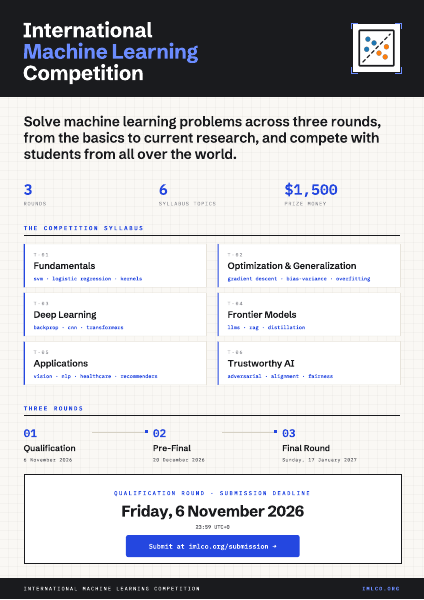
Solve machine learning problems across three rounds, from
the basics to current research, and compete with students
from all over the world.
maximum-margin classifierthe evolution of machine learning
About
Understand AI. Don't just use it.
IMLC is a competition about how machine learning really
works. You do not need to be an expert to participate: the first round needs no more than curiosity, school math, and a drive to learn. Each round builds on the previous one, so digging deeper into the topics is rewarded! Starting from
the fundamentals, you work your way up to
cutting-edge machine learning research.
a.
Learn by solving
The problems are the lessons. Each round builds on the last and we guide you through the material to make you succeed in each round. You do not need a powerful computer or a paid course.
b.
A real competition
Each round decides who advances, and the final ranking earns gold, silver and bronze awards. Participants come from over 190 countries.
c.
For your future
What you learn here lays the groundwork for studying or working in machine learning, and for understanding the systems that will soon be part of everyday life.
Looks hard? Good. Solving problems like this is how
you learn it. And every point counts.
Two attempts to train the same model, on training data and on new data.
The panels follow two training runs, A and B. On the
left, both end up looking equally good. On the right,
they do not. Which run would you trust with new data,
and what happened to the other one?
Q4.A bank uses a model to
spot fraudulent card payments. Only 1 in 200 payments
is fraudulent, so a model that simply answers "not
fraud" every single time is correct 99.5% of the time.
(a)Why is this model useless despite its high accuracy?
(b)Propose a way of scoring fraud models so that this trick cannot win.
"…storing the model's weights with 4 bits instead
of 16 cuts memory use to a quarter, with almost no
loss in accuracy…"
P2.From a recent research
paper. What does "almost no loss" leave open, and what
experiment would you run to check the claim?
Participate
The clock is already running.
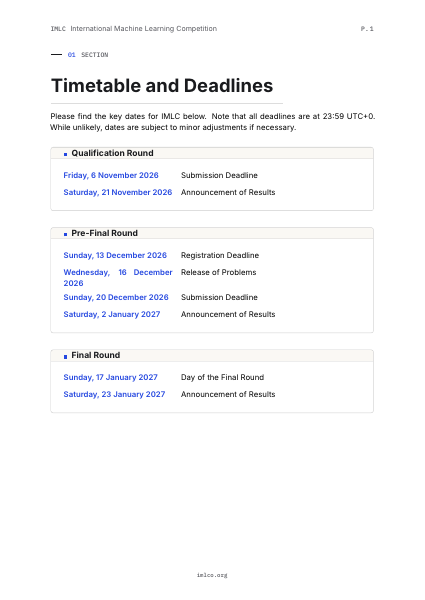
Solutions for the qualification round are due by
Sunday, 13 December 2026.
Six areas, one spectrum: the fundamentals that never
change and the research that changes every month. Every
round draws on all of it.
T·01
Fundamentals
SVMs, logistic regression, decision trees, kernels: the classical core, derived by hand. This is the math everything else stands on.
svm · logistic regression · kernels
T·02
Optimization & Generalization
How machines actually learn: gradient descent, loss landscapes, regularization, and why models that merely memorize fail to generalize.
gradient descent · bias–variance · overfitting
T·03
Deep Learning
Backpropagation by hand, then the architectures that took over: CNNs, RNNs and the transformer, understood layer by layer.
backprop · cnn · transformers
T·04
Frontier Models
The current research edge: LLMs, fine-tuning, RAG, and the efficiency work, from quantization to distillation, that makes them deployable.
llms · rag · distillation
T·05
Applications
Where it all lands: vision, language, healthcare, recommender systems, science. The same methods, translated into systems people rely on.
vision · nlp · healthcare · recommenders
T·06
Trustworthy AI
Adversarial attacks, robustness, alignment and fairness: how models fail, how they get attacked, and what responsible deployment demands.
adversarial · alignment · fairness
Rounds
Three rounds over five months.
Each round raises the stakes: first the fundamentals, then
a real research paper, then one final exam where everything
comes together. See the full rounds & process →
R1
Qualificationuntil 13 December 2026
Qualification Round
Start here. A set of questions on the core ideas
behind machine learning, from how models make
decisions to how they learn from data. Score
15/17/20 points by age group
to move on to the next round.
online · solo/group work · at your own pace
R2
Pre-FinalSunday, 24 January 2027
Pre-Final Round
You receive a recent research paper on a topic in machine learning. Study it, then sit a supervised
60-minute exam:
questions about the paper, plus two conceptual problems.
Registration is 12 EUR, and
financial aid is available
for anyone who needs it.
research paper · supervised exam · three problems
R3
FinalTuesday, 23 February 2027
Final Exam
One timed 40-minute exam
that brings everything together: the foundations, the
modern models, and the judgement to reason about both.
The top finishers earn awards. Results announced
1 March 2027.
See all awards →
Ambassadors bring the competition to their schools,
universities and communities. You spread the word, mentor
newcomers, and grow a local ML community. We support you
with materials, a certificate and an international network.
Share the competition at your school or university and on local channels. Every registration through you counts toward your ambassador level.
b.
Support
Help participants in your region with questions about rounds, registration and preparation.
c.
Grow
Advance through ambassador levels, earn certificates and references, and join an international network of ML enthusiasts.
FAQ
Frequently asked questions.
Pick a topic or search. Answers open right here. The full list lives on the
Support & FAQ page.
No matching questions. Try a different term or visit the Support page.
The International Machine Learning Competition (IMLC) is an international competition where students learn how machine learning really works by solving problems, from the basics to current research. Today, machine learning is behind most of what is called AI: everyone uses these systems, but few people learn how a model is trained, why it makes the predictions it does, and when it breaks. IMLC gives students the chance to explore this field beyond what the typical school curriculum offers, and to compete with students from all over the world. No prior experience is needed to start.
Internationality, Digital Accessibility, Real-World Research, Adjusted Difficulty, Online Tools for Teachers, Supportive Alumni Network, and more. All details are available here: About IMLC
Yes, of course!
Everyone has to submit their own solution papers in all rounds. However, for the Qualification Round, you are allowed to work on the problems with your friends and classmates together. Working together or receiving help from other people is not permitted in the Pre-Final and Final Round. You can find more about rules and cheating policy here: Cheating Policy
Yes, all of your IMLC certificates have verification IDs. This enables others to verify the authenticity of the certificates and documents: Verification page
Comparing the International Machine Learning Competition to other competitions can be misleading: IMLC does not intend to be an alternative to established competitions or their national variations and actively encourages students to take part in such opportunities.
Instead, IMLC serves as a supplementary program designed to engage a wide range of students, particularly those just beginning to develop an interest in machine learning and related subjects. It focuses on accessibility, making it a platform for students of all skill levels to explore and grow their understanding of how machine learning models work.
The International Machine Learning Competition is an independent educational program. More information about the history, organization, and funding is available here: About IMLC
Such an international competition has several expenses, including human resources, technical infrastructure, materials, and much more. The costs are covered by sponsors and partners as well as through the participants via the Pre-Final Round registration costs: More Information. Financial aid is available to assist socio-economically disadvantaged participants: Financial Aid.
The International Machine Learning Competition takes place primarily online and is accessible to students around the world; you do not need to travel somewhere to participate. The organizing team is constantly evolving, with most team members and technical infrastructure being located in Germany. There are also many other people around the world, such as the IMLC ambassadors, who do their best to make this competition a valuable experience. More information and contact details are available here: Contact Information
The training page gives tips, book recommendations, and a comprehensive collection of problems from previous years: Training and Preparation. Additional resources and links related to machine learning are available here: Resources and Links. This also includes the following: Videos, Lecture Notes, Presentations, and Infographics. We also provide a list of special resources for teachers and educators: Teaching.
Participant accounts stay active only for a limited time after the Final Round has been completed. All participant accounts will be deleted at the beginning of each new edition of the year. If you need to recover your old certificates, please contact us.
The solutions are usually published on our training page a few weeks after the Final Round of the last edition has concluded. You can find the training page here: Training Problems
All current high school and university students are allowed to participate. However, there are different age groups: Age Groups
Yes.
Your grade/age on the day of the submission deadline of the Qualification Round (i.e., 13 December 2026) determines your age group, and it will not change throughout the competition.
Current high school and university students from all grades and countries are eligible to participate in three groups:
Junior: 10th Grade and below (and < 16 years of age)
Youth: 11th to 13th Grade (or ≥ 16 years of age)
Senior: 1st Year College/University and higher (or ≥ 19 years of age)
Students from all age groups will receive the same problems in all rounds. However, students in higher groups need to score more points to qualify for the next round: More Information
Yes, you have to be a student in a high school or a university to participate. If you are currently between high school and university (e.g., gap year) and plan to start university any time soon, you are also eligible to participate.
Yes, we will send participation certificates (soft copy) to all participants regardless of the results.
You can find more information about the awards and prizes here: All Awards and Prizes
All participants who use professional computer programs (e.g., TeX) to write down their solutions receive a special honorary note on their certificates.
Since the International Machine Learning Competition is a global competition with participants from various countries, we honour the top three participants from each nation who achieve at least 50% of all points in the Final Round with a special national award certificate. A list of the top national scorers will be published on our website.
We will send all results & certificates via e-mail, and they are accessible through your participant account: Login
No, all participants (regardless of the results) receive certificates.
We will send hard copies of the certificates to all international 1st, 2nd and 3rd Prize winners. All other participants, including the Finalists, will receive a soft copy version of the certificates, which also includes a permanent verification-ID (imlco.org/verify).
Yes, there are school awards to honour the efforts of the teachers and the schools. The awards are not connected to a cash prize. Teachers who supervise students in the Pre-Final Round Exam receive a certificate for their commitment. All Awards & Prizes
Schools participate automatically if a student registers with the school's name. (Please make sure that all of your students write the school name correctly and in the same format.)
Participants who receive at least 50% of the total points in the Final Round are awarded, depending on their relative score, Gold, Silver, and Bronze Honours in the ratios of 1:2:3. Therefore, around 16% and 34% of the participants receive a Gold and Silver Honour, respectively. All other students (with at least 50% of the total points) receive a Bronze Honour.
We cannot modify or reissue any documents from past editions.
The international award winners receive hard-copy certificates, which are shipped to their home address, as well as all participants who request a Finalist Package. The packages are prepared and shipped, typically two weeks after the announcement of the Final Round. Dispatched documents usually arrive within two weeks. As international shipping times can vary significantly, it may take up to two months for the documents to arrive. A shipment confirmation is sent out as soon as the documents are in transit.
The submission should include the solution to the problems of the Qualification Round 2026. Depending on your age group, you need a certain number of points to qualify for the next round: Age Groups. You do not need to include your personal information (such as name, school, e-mail, etc.).
No. You can (a) write your answers in the blank space below the questions. However, you can also (b) write your solutions on a separate sheet of paper or (c) type your solution on a computer. In cases (b) and (c), you do not need to write down the wording of the problems again.
Please write down your approach and the steps you performed (such as mathematical operations).
We accept PDF files and picture files. We do not accept any other formats, including Word and ZIP files.
No, you participate in IMLC by submitting your solution.
Some submissions will be deleted during the evaluation process due to one of the following reasons: (1) It was not possible for us to open your file. In this case, you usually receive an e-mail from us. (2) The file was unrelated to IMLC or did not contain any solutions and was thus regarded as spam. (3) The file barely contains any solutions to the problems and was thus regarded as spam, e.g. files that contain only answers to one problem written in a poorly formatted way are usually deleted.
To change your personal information, please use the login page and click on 'Edit Details'. You can no longer change your details after the Pre-Final Round.
While English is the recommended language, you can write your solution in any of the languages in which the IMLC website is available (English, German, Arabic, Japanese, Chinese, French, Spanish, Italian, Russian, Portuguese, Vietnamese, Korean)
(1) Check whether your submission was already successful on this page: Login. (2) If your submission/e-mail was not found, use a different browser, use a different computer or laptop, or try to compress your file. (3) If nothing works, please get in touch with us.
The time zone is UTC+0 for all deadlines.
The results of the Qualification Round will be announced on Monday, 28 December 2026. You will receive an information e-mail and you can view your results online by this date: Login
The submission deadline is Sunday, 13 December 2026, 23:59 UTC+0.
Yes, until the submission deadline, Sunday, 13 December 2026. Please log into your participant account and click on 'Edit Details'.
No, we do not accept any submissions or solutions that we receive via e-mail. You have to submit your solution via the official submission form: Submission
No. You do not need all points to qualify for the next round. The number of points required depends on your age group (Age Groups).
We expect a sufficiently comprehensive answer that outlines what you believe is necessary to answer the question. The space provided on the page is usually enough when having medium-sized handwriting. More comprehensive answers are welcome.
The Pre-Final Round consists of two phases: (1) Preparation Phase: Starting on Friday, 22 January 2027, all qualified and registered participants will receive a research paper via email and their participant account. You should read and familiarize yourself with this paper. (2) Exam Phase: Between Sunday, 24 January 2027 and Tuesday, 26 January 2027, you will take a supervised 60-minute exam via the online exam platform at https://imlco.org/exam. The exam includes three problems (one basic, one advanced, and one research problem) that you will solve on paper and then scan and upload.
No. You do not need all points to qualify for the Pre-Final Round. The number of points required depends on your age group (Age Groups).
No, a stamp is not required for the Pre-Final Round. Teachers register online at https://imlco.org/teacherinfo and do not need to submit any physical forms or stamps. The IMLC team will review and approve or reject the teacher registration within a few days.
No. A teacher must supervise the Pre-Final Round Exam in person. The teacher is not allowed to supervise you via an online call (for example, Zoom or Skype). If you do not have a teacher available, please use the online supervision system instead.
You can find examples here: https://imlco.org/docs/Photo_Examples.pdf. The photo should show the exam conditions and environment, including the student taking the exam in front of the device and the device screen displaying the exam.
No. You must ensure that there is a steady internet connection during the exam and that your browser is up-to-date. You are responsible for any technical issues. It is not possible to pause, continue, or retake the exam once you have started.
Yes. You have up to 60 minutes to complete the exam, but you may finish earlier if you complete all problems before time runs out.
Yes, you are allowed to bring blank sheets of paper (not more than twenty) and pens (not more than three) to write your solutions during the exam. You should use a new sheet of paper for each problem and write the problem number at the top of every page.
If you do not have a teacher available to supervise your Pre-Final Round Exam, you can use the online supervision system. You will need a computer, laptop, or phone with a webcam (exam device), a second phone with a camera and microphone (supervision phone), and a valid government-issued ID or passport. You will select an exam timeslot, complete the setup and verification steps, and take the exam under online supervision. More details can be found in the Pre-Final Round information document.
Yes, you can take the Pre-Final Round Exam on your phone. However, if you use your phone as your exam device and choose the online supervision option, you will need a second phone for the supervision system. For this reason, we strongly recommend using a laptop or computer for the exam.
After you log in to the Pre-Final Round Exam platform at https://imlco.org/exam, an approval code will be displayed on your screen. Your teacher must enter this code into a form that appears in their teacher account to approve and start your exam.
If a teacher supervises multiple students at once and the participants start the exam simultaneously, it is sufficient to enter only a single approval code if all participants arrive at the approval page in the Pre-Final Round Exam platform.
The person supervising your Pre-Final Round Exam must be an active teacher (not retired) employed at a government-accredited school or university. The teacher must currently be an active teacher or professor and must not be related to you (no family members). The teacher must be able to prove their employment and teaching duties.
To qualify for the Final Round, you must score at least 8/10/12 points out of 18 possible points in the Pre-Final Round. The Pre-Final Round consists of three problems: one basic problem (4 points), one advanced problem (6 points), and one research problem (8 points).
If you have successfully qualified from the Qualification Round and registered for the Pre-Final Round, you can access the exam platform at https://imlco.org/exam by logging in with your IMLC participant account credentials during the exam period (between Sunday, 24 January 2027 and Tuesday, 26 January 2027).
First, inform your supervisor (if using teacher supervision). Take screenshots of the encountered issue if possible, then try to reload the exam page (and log in again if necessary). After the exam, if we detect any time irregularities, you will have the option to explain any technical issues that occurred.
The approval code is used to verify that you are currently being supervised by your teacher. You need to give this code to your teacher so they can enter it into their teacher account to approve and start your exam. After successful verification, the exam will automatically progress to the next page.
Your teacher must register online at https://imlco.org/teacherinfo. The IMLC team will review the registration and approve or reject the teacher within a few days.
Unfortunately, we cannot provide you with teachers to supervise your Pre-Final Round Exam. Please contact teachers at your school or other nearby schools. If you cannot find a teacher, you can use the online supervision system instead.
No. The teacher can be from any government-accredited school or university, as long as they meet the requirements (active teacher, not retired, not related to you).
No. The teacher can teach any subject, as long as they are an active teacher at a government-accredited school or university.
Yes. A single teacher may supervise the exam for multiple participants at the same time. If there are other Pre-Final Round participants from your school, it is required that the same teacher supervises all students simultaneously. Please contact your teacher and inform them about the other participants.
Please ask another teacher who meets the requirements and can prove their employment at a government-accredited school or university. The rejected teacher can also register again with additional or corrected information or documents if something was missing from their initial registration.
You can bring blank sheets of paper (not more than twenty) and pens (not more than three) to write your solutions during the exam. You can bring a calculator. You may also bring something to drink. No other materials or tools are allowed. You are not allowed to bring your own copy of the research paper, but it will be available in the exam interface. Your computer, laptop, or phone must only be used to access the exam platform at https://imlco.org/exam.
The preparation phase begins on Friday, 22 January 2027 when all qualified and registered Pre-Final Round participants receive a research paper via email and through their participant account. During this phase, you should read and familiarize yourself with the research paper, as one of the exam problems (the research problem worth 8 points) will require you to apply concepts from this paper. The paper is in English, but you may use translation tools and AI to help you understand the material.
The research paper is provided in English only. However, you may use translation tools and AI to help you comprehend the material and translate it into your preferred language.
The exam questions will be available in multiple languages. The specific languages available will be displayed in the exam interface when you log in.
After the 60-minute exam finishes, you will have 10 minutes to upload clear scans of your written solutions using your phone. You will scan a QR code shown on the exam screen, which will take you to the upload interface. If you use your phone to take the exam, you will need a second phone for scanning and uploading. This is why we strongly recommend using a laptop or computer for the exam itself. Make sure to write clearly, use a new sheet of paper for each problem, and write the problem number at the top of every page.
No. If you choose teacher supervision (Option A), your exam will not be recorded via webcam or phone. Your teacher will supervise you in person and take a photo of the exam conditions during the exam. The online supervision system with webcam and phone recording is only used if you choose the supervision without teacher option (Option B).
The Final Round is a single 40-minute online exam with around 30 questions. The exam takes place at home via an online exam portal and is supervised using an online supervision system (no teacher supervision required or allowed). The exam includes two types of questions: (1) Short-answer questions (1-2 minutes per question; 1-2 points): Give a single word or number as response. (2) Multiple-choice questions (1 minute per question; 1 point): Select the correct answer from four options. Questions are shown one-by-one for a limited time, and you cannot go back to previous questions. You can use blank paper and pens for notes, but calculators, written notes, and the Pre-Final Round research paper are not allowed. More information: Final Round Information Flyer
We will use international shipping to deliver all of the 1st, 2nd, and 3rd prizes; there is no need to travel somewhere. The national awards and Final Round honours will be sent digitally as a soft copy.
The Final Exam takes place on Tuesday, 23 February 2027. You must select your specific time slot in advance at https://imlco.org/schedule-exam. All time slots are scheduled in the evening in your country's time zone. We recommend selecting your slot early, as each slot can accommodate a limited number of participants.
If the participant has successfully completed the Pre-Final Round, it is possible to access the Final Exam via the Final Exam webpage by logging in with your profile credentials.
No. The participant must give the final answer to each question within the dedicated time window for that specific question.
If you experience technical issues during the exam, try to reload the exam page and log in again if necessary. Take screenshots of any issues encountered. After the exam, if we detect any time irregularities, you will have the option to explain any technical problems that occurred. However, you are responsible for ensuring a stable internet connection and up-to-date browser before starting the exam.
The Final Round consists of around 30 questions and takes around 40 minutes. The exam includes two types of questions: (1) Short-answer questions (1-2 minutes per question; 1-2 points): Give a single word or number as response. (2) Multiple-choice questions (1 minute per question; 1 point): Select the correct answer from four options. Questions are shown one-by-one for a limited time. There are no negative points for incorrect answers.
You can use blank paper and pens during the exam for notes. Not allowed: Calculators, written notes, or the Pre-Final Round research paper. The computer/laptop/phone must only be used to access the Final Exam website.
In this case, the results of the Pre-Final Round and of the Qualification Round will be used to determine the final winner based on the total points. If the tie remains, both participants will receive the same award and split the cash prize. However, this has never happened before.
The results of the Final Round and IMLC will be announced on Monday, 1 March 2027.
No, you cannot redo or continue the exam later. You must ensure a stable internet connection and that your browser is up-to-date before starting. It is not possible to pause, continue, or retake the exam once you have started.
Each question has a dedicated time window (1-2 minutes depending on the question type). You can answer the question in less time and move to the next question. However, you cannot go back to previous questions, and you cannot skip questions without submitting an answer (leaving a question blank counts as skipping it).
Yes, you are allowed to bring a blank piece of paper and a pencil for note-taking during the exam.
Yes, it is allowed to do the exam on your phone.
You can find examples here: https://imlco.org/docs/Photo_Examples.pdf. The supervision phone must be positioned to capture: (a) your upper body and partial face, (b) your hands and the sheets of paper in front of you, and (c) the screen of your exam device. The phone should be placed to your left or right side, slightly behind you, at an angle that allows the camera to clearly capture all three elements. You may use stable materials or stands to position your phone at an acceptable angle.
Yes, the supervision phone's microphone must be enabled to record the surrounding sound during the exam.
You will receive a link via email and through your participant account when timeslot selection opens. Timeslots are available at regular intervals throughout the exam period. Each timeslot can accommodate a limited number of participants, and they are assigned on a first-come, first-served basis, so we recommend selecting your slot early. Once you select a timeslot, you will know exactly when to log in to begin your exam.
To take the exam using the online supervision system, you will need: (1) A computer, laptop, or phone with a webcam (exam device), (2) A second phone with a working camera and microphone (supervision phone), and (3) A valid government-issued ID card or passport. All devices must be connected to the internet and have sufficient battery or be connected to power. You will also need a stable internet connection throughout the exam.
If using the online supervision system, the following requirements apply: Only your exam device, ID card, blank sheets of paper, pens, and something to drink are allowed. The room must be closed with the door shut. No notes, posters, or other materials may be in your field of view. No additional phones, monitors, or electronic devices may be present. No other person may be in the room. No noisy environments. No headphones. You are not allowed to leave the exam environment at any time during the exam or before your answers have been scanned and uploaded. Using the restroom is not permitted once the exam has started.
The supervision phone must be placed to your left or right side, slightly behind you, at an angle that allows the camera to clearly capture: (1) Your upper body and partial face, (2) Your hands and the sheets of paper in front of you, and (3) The screen of your exam device. You can find examples of acceptable angles at https://imlco.org/docs/Photo_Examples.pdf. We recommend preparing and testing your exam setup beforehand. You may use stable materials or stands to position your phone at an acceptable angle.
If you are using the online supervision system, you are required to connect your supervision phone to a charging cable during the exam setup. This ensures that your phone remains powered throughout the entire exam and supervision period. Make sure to have a charger and power outlet available before starting the exam.
You are responsible for ensuring a stable internet connection and power supply throughout the exam. It is not possible to pause, continue, or retake the exam once you have started. If you experience internet or power issues during the exam, you may try to reload the exam page and log in again if possible. After the exam, if we detect any time irregularities, you will have the option to explain any technical issues that occurred. However, we recommend ensuring reliable internet and power before starting the exam to avoid any disruptions.
The IMLC competition is free to enter for all students from around the world. However, all students who have qualified and want to register for the Pre-Final Round have to cover the registration costs of 12 EUR to make this year's competition possible. You can find further information here: More Information. Financial aid is available to assist socio-economically disadvantaged participants: Financial Aid.
This educational opportunity comes with diverse costs, including those for human resources, technical infrastructure, materials and more. While our sponsors cover some of these expenses, we need to ask participants to cover this year's Pre-Final Round registration costs to make IMLC on an international level possible. The registration costs are necessary to provide the resources for the evaluation and, in particular, for the comprehensive Pre-Final Round. There are no other costs involved. You can find detailed information about the registration costs here: More Information. Financial aid is available to assist socio-economically disadvantaged participants: Financial Aid.
This year's Pre-Final Round registration costs are 12 EUR: More Information.
No, the registration costs for the Pre-Final Round are the only costs that have to be covered by participants of this year's competition.
If you are successful in the Qualification Round, you can decide whether you want to register for the Pre-Final Round or not. You will always receive a certificate of your results in the Qualification Round.
Yes, you can participate in the Qualification Round and receive your participation certificate without registering for the Pre-Final Round.
We will inform all successful participants of the Qualification Round about the registration process for the Pre-Final Round. The registration costs have to be covered before the Pre-Final Round starts if you want to participate. The costs can be covered by any common payment method, such as PayPal or credit card.
Yes, the currency will be converted automatically to EUR during the payment process.
Yes, financial aid is available to assist socio-economically disadvantaged participants. We are continuously searching for additional partners who will help us reduce the overall costs further. There are some fee waivers, reductions, and regional sponsorships available each year. Qualified participants will be informed on how to apply for financial aid, along with the announcement of the Qualification Round: Financial Aid.
Yes, we provide a group payment page for teachers and schools to cover the Pre-Final registration costs for multiple participants at the same time (as a group).
Yes, you can learn more here: School Partnerships. The IMLC School Partnership Program strengthens our collaboration with schools worldwide, providing them with dedicated tools, support, and recognition for integrating IMLC into their academic activities. Partner Schools enjoy a closer connection to the competition, streamlined participant management, and access to exclusive resources that benefit students, teachers, and the broader school community.
Yes, teachers and schools are invited to share this opportunity with their students. You can use all problems, posters, and materials. The registration form for teachers is available here: Registration
We have implemented an online tool to check the submissions and results of your students: Login
Yes, there are school awards to honour the efforts of the teachers and the schools. The awards are not connected to a cash prize. Teachers who supervise students in the Pre-Final Round Exam receive a certificate for their commitment. All Awards & Prizes
Yes, we provide a group payment page for teachers and schools to cover the Pre-Final registration costs for multiple participants at the same time (as a group). Group payments can be made here.
As soon as your teacher is approved, they can log into the teacher account and add you as a student by clicking on the button 'Add Student'. Your teacher has to enter your year of birth and e-mail. Please note that the e-mail must be the exact e-mail with which you are registered for the competition.
The International Machine Learning Competition involves students from around the world and extends far beyond the annual competition. Our official ambassadors represent IMLC in their schools, universities, cities, and countries. Ambassadors coordinate local groups, organize activities and promote IMLC in their community. Being an IMLC Ambassador allows you to inspire students for machine learning and to prove your skills as a coordinator in a global network.
You have a public profile on our website, which clearly indicates your ambassador role. Additionally, you are listed on our team page and also have an ambassador email address. If needed for your activities, our team can also be contacted to confirm your ambassador role.
Please log in to your ambassador account and click on 'Add Activity'. There, you can describe your activity and upload up to five pictures.
As an IMLC Ambassador, your mission is to spark curiosity for machine learning, deepen the interest in the field among students, and support the IMLC initiative in your region through the following key responsibilities:
Promoting machine learning by organizing activities and raising awareness in your community.
Building a local machine learning group by bringing together interested students and creating a space for ongoing activities.
Increasing local participation by encouraging students from your school, city, or country to take part in IMLC.
Supporting participants by answering questions, offering guidance, and acting as a local point of contact.
Besides collecting career experience as part of our global network, ambassadors enjoy various other hands-on benefits:
Opportunity to represent IMLC in your region and build your own local student group or machine learning club.
Official IMLC Ambassador Certificate awarded to all active ambassadors who engage in outreach.
Valuable career and leadership experience as part of an international education network will strengthen your CV.
Priority consideration for financial aid for the Pre-Final Round registration costs (Learn More).
Access to financial support through the Ambassador Engagement Support program (Learn More).
Recognition on the IMLC website and social media channels for your outreach and activities.
Eligibility for the annual IMLC Ambassador Awards and exclusive rewards from the IMLC team (see below).
Access to study opportunities and scholarship information shared through the IMLC network.
You have to be at least 14 years old, interested in machine learning, and willing to spend time encouraging students to engage with machine learning and IMLC. Basic English proficiency is required to communicate with the international IMLC team.
You can find a link to your ambassador certificate in your ambassador account. Please note that a certificate will be issued to active ambassadors only (i.e., at least three added activities and at least one Pre-Final Round participant associated with your ambassador profile) after the Pre-Final Round announcement (8 February 2027).
A certificate will be issued to active ambassadors only. You qualify as an 'active ambassador' if you have at least three added activities and at least one Pre-Final Round participant associated with your ambassador profile. Please inform participants to select your name during the submission process or forward your personal ambassador submission link.
To award active ambassadors with long-time experience, ambassadors can rank up to five levels depending on their (i) commitment to IMLC, (ii) contribution to raising awareness and assisting fellow students, and (iii) frequency of organizing local activities & events:
Newcomer
Experienced
Accomplished
Distinguished
Honoured
The ambassador score is determined by 10×QR + 20×PF + 30×F where QR, PF, F are the total number of participants in the Qualification, Pre-Final, and Final round associated with you as an ambassador. Participants from all previous editions are included. Participants can select their ambassador on the submission form.
Once you are approved, you are an ambassador without the need to apply again in the future. However, the IMLC team removes all inactive ambassadors (no participants or activities) each year. If you have been removed but want to continue as an ambassador, you must apply again.
In general, we do not recommend creating a local IMLC social media page as information published on the official IMLC social media page is relevant to all participants, and a separate page might be misleading for some students. However, feel free to create local city- or school-level social media groups, etc., to encourage and coordinate your local IMLC group.
Special awards are given each year to the most active ambassadors to honour their excellent and responsible performance. This includes awards for encouraging many participants as well as for coordinating many activities. However, your main purpose of becoming an ambassador should always be to inspire youths! You find more information here: Awards and Prizes
Yes.
No, the ambassador program runs continuously.
No, please submit your original transcript if no English version is available. However, please submit an English transcript if available.
The application for becoming an ambassador consists of two stages:
1st Stage: You will complete the official ambassador application form by providing your personal details and submitting the following documents: a letter of motivation, your CV, academic transcript, and any optional certificates. Once we receive your application, our team will review your materials and typically contact you within seven days.
2nd Stage: Successful candidates will be invited to the second stage, where you will be asked to submit additional materials. These include a personal introduction video and your solutions to a short set of machine learning problems designed specifically for you. We will inform you of the final decision usually within seven days.
To begin the first stage of the application process, please complete the official ambassador application form: Ambassador Application Form
There are two ways: (a) You can inform them to select your name at the 'Your Ambassador' selection on the Qualification Round submission form. (b) You can send them your personal ambassador submission page link (see your ambassador account). Note: Participants who have selected you must first confirm their submission by clicking on the link they receive in the confirmation e-mail before they will be connected to your ambassador account.
Financial transfers are made via international bank transfer or PayPal. While we support most major currencies, please note that the availability of some payment methods may be limited depending on your country. Nevertheless, we will do our best to ensure that all qualifying ambassadors receive their financial support. Learn More
No application is required to receive this support. If you qualify based on the number of Pre-Final Round participants, you will automatically be contacted by the IMLC team after the Final Round to confirm your interest in receiving the financial support. The amount you qualify for is also visible in real-time through your ambassador account. Learn More
To support your continued outreach and local machine learning activities, IMLC offers financial support to ambassadors who actively encourage student participation in the International Machine Learning Competition, particularly in the Pre-Final and Final Rounds. This financial support is intended to help you organize further local activities, support your machine learning group or club, produce promotional materials, or cover basic outreach expenses. It is intended to strengthen your ability to fulfil your role as an IMLC Ambassador and inspire more students in your region.
The amount of financial support is based on the total number of confirmed Pre-Final Round participants associated with your ambassador account, and the financial support will be provided after the conclusion of the Final Round each year. A minimum of 25 Pre-Final Round participants is required to be eligible for the Ambassador Engagement Support.
You can find more details about the financial support here: Learn More
All ambassadors receive a personal IMLC e-mail address as a professional channel for communication. Our team will activate and contact you usually a few days after you have been accepted into the Ambassador Program.
No, however, active IMLC Ambassadors are given priority consideration for financial aid to cover the registration costs for the annual Pre-Final Round of the competition. This support is intended to recognize and assist ambassadors who have shown high commitment through outreach and participant engagement. Typically, ambassadors who have successfully encouraged five students or more to participate in the Pre-Final Round of the current or last year's edition of IMLC received financial aid. While financial aid cannot be guaranteed, ambassadors with active profiles and documented outreach have significantly higher chances.
Yes, you should have a basic command of English to become an ambassador, as you work between the international team and the local participants. The application materials (in particular the application letter and video) must be submitted in English.
We check all uploaded images. If your image is not shown, it does not satisfy the requirements for a public ambassador picture:
Professional and high-quality picture.
Format: square (same width and height; preferably 400 x 400 pixels).
No border, no blur, and no digital altering.
No watermarks, text, or transparency.
No inappropriate faces, poses, or clothing.
Positive facial expression and professional posture.
This is likely because the participant has not yet confirmed their e-mail via the link in the submission confirmation e-mail. Participants must confirm their participation before they appear in your account or are credited to your ambassador score. If they did confirm their registration, please ask them to make sure they have selected you as their ambassador: Participants can change their ambassador selection via their participant account until the Qualification Round deadline.
Yes, all ambassadors need to upload quarterly reports to update the National Ambassadors and the international team about their outreach. This is in particular important if there is a National Ambassador in your country. You can upload the report via your ambassador account and will receive a reminder e-mail. This report does not replace the need to add your activities frequently.
National Ambassadors are ambassadors who play a leading role in representing IMLC within their countries. This honorary and strategic position offers committed ambassadors the opportunity to coordinate national-level outreach, manage ambassador communities, and strengthen IMLC's visibility and participation at a national scale. Learn More